

1. Introduction to the significance of SEO
Search Engine Optimisation (SEO) involves working on your website and its content with the sole aim of improving its ranking in Google's natural results. A website that works on its natural referencing has a better chance of appearing in the first results of search engines.
Whether you’re a small business owner or run a Fortune 500 company, SEO has an enormous impact on the success of your business. Your SEO strategy determines how easily your target customers can find you. Given that 75% of internet users don’t even look past the first page of search results, that’s no easy task.
2. Targeting relevant keywords
Keyword research is the foundation of any good SEO strategy. If you know how to use keywords effectively, you can develop content that attracts more people to your website. The first step is to identify your page’s primary and secondary keywords.
Your primary keyword is the main focus of your content. You only need to pick one primary keyword per page. It should be relevant to what your page’s focus, your brand identity, your products, and your services.
Your secondary keywords support the main topic. You will probably have several of these. Often, they’re more granular than the primary keyword and represent subtopics you’re covering throughout an article. Try to include them naturally in your content, but don’t force them if they don’t fit.
3. Creating quality original content
If you want users to find and return to your site, you need quality content that is original, comprehensive, and evergreen.
Original content shows the audience your unique perspective and expertise and enables them to build a relationship with you. What’s more, search engine algorithms, especially Google, are designed to sniff out unique content. Those who practice good SEO and publish trustworthy original content are likely to increase searches.
Ideally, your content should be comprehensive. That means the content you publish answers everything a user might want to know about that topic. Comprehensive pages help show search engines that you’re an authority on that topic.
Finally, evergreen content has long-term value, which will continue to be relevant and generate traffic over a long period. Inbound marketing is the gift that keeps on giving because it continues to produce results while your focus is elsewhere.
When creating evergreen content, think about what topics will bring long-term value to your readers without needing significant updates. Try to avoid seasonal, breaking news stories, or time-sensitive data stories. These pages are unlikely to remain relevant over time.
4. Formatting content for search engines and featured snippets
If you want the content you write to perform well, make sure you’re answering the questions your audience is asking. One way to do this is to target featured snippets.
Featured snippets appear at the top of the search results page on Google. They’re designed to answer a user’s question without requiring them to leave the page. They’re highly visible, helpful, and likely to attract organic traffic since they appear before numbered results. You might also see them referred to as SERP features.
These positions are highly sought after by digital marketers. To win one, you need to optimize your content to target them. The strategies you use to target featured snippets can make your content more helpful to readers and improve your SEO, even if you don’t win the snippet in question.
5. Optimizing "Page title" and "Meta description"
Your page title and meta description might be the first thing your audience ever sees. Users might decide whether to click or skip your page in the their browser search result. That’s a lot of power for so few words, so make sure they’re impactful.
Typically, whatever platform you use to host your website offers an easy way to edit your page title and meta description.
Here are a few tips to remember:
- Keep your page title between 30 and 60 characters.
- Keep your meta description under 160 characters.
- Include your target keywords.
- Communicate what your page is about and what makes it unique.
- Make sure your title and meta description are unique for every page
6. Improve your meta title to boost your SEO
Attract attention, boost SEO and improve the user experience with optimised meta titles.
Why is the meta title so important?
- It's the first thing users see in search results. It's your chance to make a good impression and encourage them to click through to your site.
- Search engines use it to understand the content of your page. A well-optimised meta title can improve your ranking in search results.
- It can improve the user experience. A clear and informative meta title lets users know what to expect when they click on your site.
How do you optimize your meta titles?
- Include your main keywords. But don't overdo it! Keyword stuffing can harm your SEO.
- Be clear and concise. Your meta title should be between 50 and 60 characters.
- Use punchy language. Your meta title should be catchy and make users want to click.
- Be unique. Each page on your site should have a unique meta title.
- Test and optimize. Use SEO analysis tools to monitor the performance of your meta titles and make changes if necessary.
By optimizing your meta titles, you can significantly improve your website's SEO, increase organic traffic and provide a better user experience. Don't forget that the meta title is a crucial element of SEO, but it must be used in conjunction with other good SEO practices to achieve optimum results.
7. Using short descriptive URLs
Improving your URL structure can significantly impact your on-page SEO with relatively little effort. A clean URL can help search engines understand your page and gives you a more user-friendly appearance in the SERPs.
Best of all, it’s relatively easy to do, even for SEO beginners.
An effective URL should:
- Use keywords: Try to include your primary keyword, if you can
- Be readable: When your visitor reads the URL, it should be easy for them to understand what the page is about
- Be concise: Shorter URLs (around 60 characters) are preferable. That’s because many search engines can’t process longer URLs and might rank you lower as a result.
8. Define a canonical URL for duplicated content
Search engines do not display duplicate content. If you need to duplicate the same content, for example the same article on German Global Distrib and German Retail or Institutional France and Institutional Belgium, you must always define which URL should be indexed by search engines.
To do this, on the duplicate content page template, you must define the URL page to be indexed.
- On the template, column right, click on "Meta Tags".
- Scroll to "Canonical URL" and add the URL to be indexed (master content).
9. SEO fundamentals
The essential for effective SEO:
- Include relevant keywords in the page title (H1) and URL of your page.
- Include strong keywords in sub-section titles (H2), such as paragraph titles and components.
- Optimizing your meta title is crucial for enhancing SEO visibility and user navigation. Meta title is the title of your page displayed on search engines. If you do not contribute this field, the meta title is automatically contributed by the AI. Despite this automation, it is strongly recommended to reread and/or reword it.
- Contribute meaningful keywords in the meta description. Meta description is used by search engines.
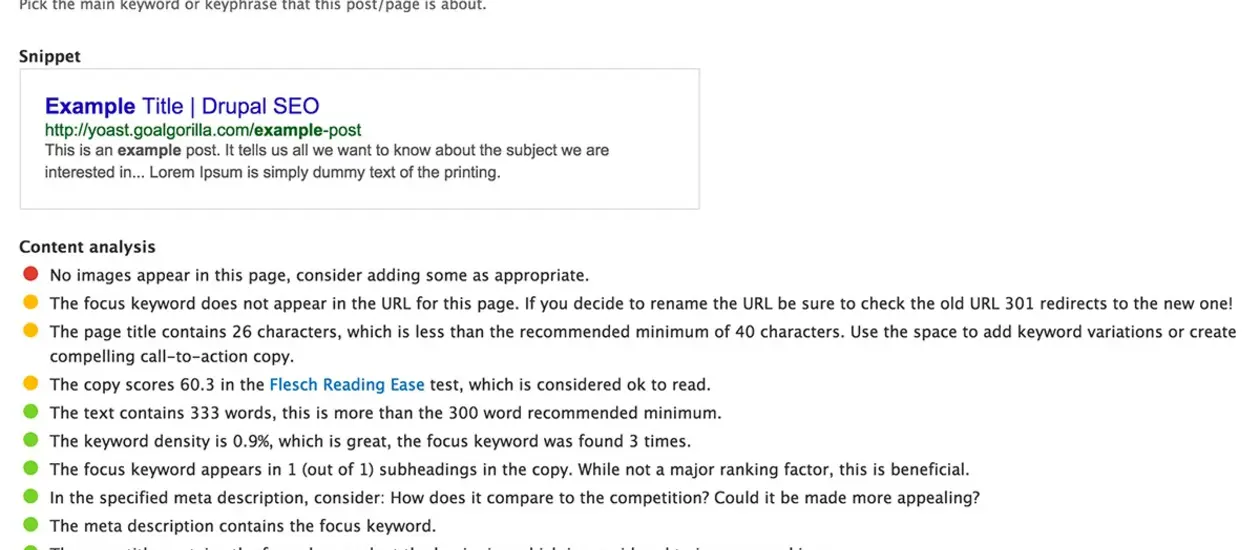
Yoast Analysis to check the SEO of each pages.
- Use Yoast Analysis for real-time page scanning, ensuring all crucial SEO elements (keywords, meta titles, descriptions) and readability factors are optimized for both search engines and users.
- Access this plugin directly while editing your template. It is located in the menu at the top of the contribution page.
10. Using Google Search Console
Google Search Console is Google’s free SEO platform and is one of the most popular SEO analytics tools. With Google Search Console, webmasters can evaluate critical SEO factors for their site, like crawling and indexing, search rankings, schema markup, page experience, backlinks, and more.
Google Search Console is useful for SEO for a few reasons, including the following:
- Data accuracy: Get data directly from Google, like whether it discovered and indexed a URL.
- Data freshness: Access fresh data (typically from the past few hours) for faster analysis.
- Data versatility: Unlock multiple data use cases, from keyword research to backlink analysis.
More info about Google Search Console
All websites can be linked to Google Search Console.